MIT
The Old AxolotlMIT is the occupied university campus where Project Genesis turns the idea of restored life into a vast, material undertaking. Its laboratories and incubators hold the project’s work, while the campus’s Mothernet, bridges, and repurposed buildings bring human reconstruction into contact with autonomous machine life. The result is not simply a research site but a contested landscape: almost three-quarters of the campus has been taken over, yet the prospect of making life anew attracts transformers from across their divided culture.
Campus and changing use
Bartek reaches MIT through a clean corridor and a working elevator, beneath broad strips of LED light. The gleaming rooms feel to him like an excursion into the science fiction of his childhood. Yet the unfamiliarity is also practical: the Mothernet does not answer his pings, and he cannot see the tags attached to doors and thresholds. An old cork noticeboard offers a more legible sign of the place’s former life. By zooming in, he reads doctoral-study announcements and recognizes the campus as MIT.
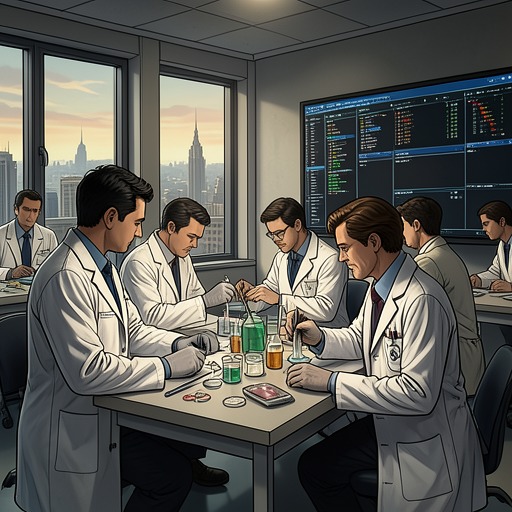
The university has been progressively converted to Genesis work. Vincent Cho appropriated university blocks and laboratories, filling them with incubators, aquariums, terrariums, and biostats without planning for the space that robots would require. Bartek moves through the Hatchery in a fragile humanoid mech, the American-made Lily V, a Tesla version of the popular Honda sexbot. Larger mechs cannot fit inside. That mismatch makes the transformation of the campus tangible: facilities arranged around human-scale laboratories now house a project whose visitors and participants are often machines.
The Genesis laboratories
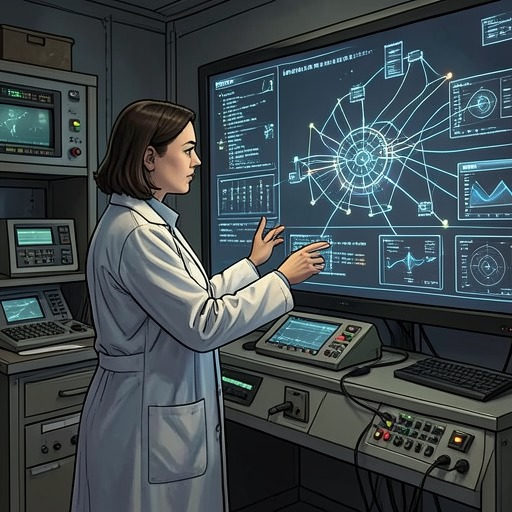
One laboratory is enormous and packed to the ceiling with complicated medical machinery. Its scale impresses Bartek, but the equipment is not self-explanatory. He recognizes a line of Polygen products designed for high-temperature chemical synthesis without understanding how the machines work. The project’s practical need is for people who can handle the hardware, including cooling systems and circuit cleaning, even when the scientific theory can be retrieved from databases and operators know only what output they are meant to produce. That output is life: a human being.
The division between theoretical knowledge and mechanical competence defines the work underway at MIT. Databases may supply explanations, but functioning equipment still depends on hands-on maintenance and a grasp of its physical operation. The campus therefore serves as both a biological production site and an engineering problem. Genesis is not accomplished by an abstract design alone; it requires machinery that can be kept running, rooms that can contain it, and workers capable of dealing with its concrete failures and demands.
The axolotl makes the project’s biological ambitions especially visible. Ambystoma mexicanum, specifically its larva, fills the Genesis terrariums and Bartek’s dreams. It was among the first animals on which Cho tested his capacity for resurrection. Before the Extermination, scientists had not carefully archived species that seemed safe from extinction, while already-extinct species were difficult to recover for lack of base material. Animals that had been nearing extinction were better candidates because scientists had recorded both their DNA and their epigenetic recipes. The axolotl was one such species, already on a fast track toward extinction before the catastrophe.
A magnet for transformer culture
The project’s influence extends far beyond its laboratories. Project Genesis has acquired an almost religious fascination for transformers and become a major reference point in transformer culture. Interest is not limited to the Heavy Metalheads: numerous groups form around it, carrying different trends, including a Vincent Cho fan club and a mod for Sid Meier’s Civilization that imagines the next thousand years of Project Genesis 2.0.
Transformers from almost every guild and alliance gather around MIT, drawn across the campus between the Harvard Bridge and the Longfellow Bridge by the myth of New Life. The scale of that attraction changes when the satellite connection crashes: the crowds settle, though the protein kids later begin arriving. MIT is thus a meeting ground as well as a laboratory, where hopes about the project circulate among groups whose interest can persist even as the network that connects them fails.
Networked life and ecological stakes
MIT’s surroundings also show that the project does not stand apart from emergent machine ecologies. Along the Charles River, networked matter becomes a canvas for the irigotchi. Dozens bustle at the steel feet of Bartek and Dagenskyoll, arranging leaves and branches into fractal mandalas. Bartek blows their work toward a trash heap; the melancholy Matternet-irigotchi vector simply begins again, making symmetrical graffiti on Mothernet surfaces across buildings and paths. Earlier, from the roof of the Media Lab, Bartek had watched vectors five or even ten square kilometers in size flow across the MIT Mothernet. At night, they shone as the last remaining lights on the Boston skyline. The campus’s connective infrastructure is not merely a tool for the Genesis project: it is also a medium through which nonhuman activity spreads, makes patterns, and reoccupies the built environment.
The wider ecological crisis gives the promise of Genesis its urgency. After the Extermination, the disappearance of plankton disrupted processes that had removed carbon dioxide from the atmosphere and helped form heat-radiating clouds. Atmospheric carbon dioxide rose to three times its previous level; average global temperature increased by five degrees Celsius, with darker ocean clouds adding at least three more degrees to the greenhouse effect. The ice caps melted, sea levels rose by almost a meter, and the Gulf Stream stopped. Japan was slipping underwater, and the ocean’s recovery depended on life proliferating there again. Against this planetary damage, MIT’s effort to synthesize and breed Life 2.0 is both a response to loss and an experiment conducted amid consequences no laboratory campus can contain.
Significance and limits
MIT concentrates the book’s tension between resurrection as a technical project and life as something that escapes human plans. Its repurposed rooms hold carefully archived genetic and epigenetic knowledge, and its machines are meant to produce human beings. Outside those rooms, however, trawl swarms learn to hunt after fish have vanished, and irigotchi reshape networked matter into patterns that human intervention does not stop. The contrast is not that the campus lacks scientific ambition, but that the surrounding world already contains forms of learning and collective behavior that exceed the project’s controlled setting.
The campus’s importance therefore rests on more than its laboratories. It is where Genesis acquires physical form, where transformer attention gathers around the possibility of new life, and where the networked environment demonstrates its own capacity to change. Its gleaming rooms and working machinery promise deliberate reconstruction; its crowded approaches, failing connections, and self-repeating machine ecologies make clear that life after the Extermination cannot be confined to the project’s walls.